Pogoda Park Narodowy Bryce Canyon — miesiąc po miesiącu
Park Narodowy Bryce Canyon — najlepszy czas na wyjazd to czerwiec, sierpień i wrzesień: 92/100 (wrzesień), 21°C i 3 deszczowe dni. Najlepsza pora to lato, czerwiec–sierpień (średnio 88/100).
Najgorszy miesiąc: styczeń, 59/100 — mroźnie, trochę deszczu, czyste powietrze. Zobacz: styczeń →
Aktualizacja: wrzesień 2026 · normy klimatyczne z reanalizy ERA5
Planujesz większą podróż? Stany Zjednoczone — najlepszy czas na wyjazd →
Najlepszy sezon: czerwiec–sierpień (średnio 88/100) · najgorzej: styczeń (59/100)
- Dni
- 21°C
- Noce
- 4°C
- Mokre dni
- 3
- Słońce
- 11.1 h
- Wilgotność
- 38%
- Długość dnia
- 12 h
Park Narodowy Bryce Canyon — miesiąc po miesiącu
Wynik komfortu w skali do 100 dla rodzaju podróży, do którego Park Narodowy Bryce Canyon nadaje się najlepiej, a do tego średnia maksymalna, deszczowe dni i godziny słońca dziennie z norm klimatycznych oraz to, jak bywa tłoczno.
Co się dzieje przez cały rok — Park Narodowy Bryce Canyon
Festiwale, spektakle natury, święta i sezony, na które warto uważać — wybrane i ze źródłami. Szczegóły są na stronach poszczególnych miesięcy.
- luty
- Bryce Canyon Winter Festival12–18 lut (zwykle)Festiwal
- marzec
- Spring break on the Mighty Five10 mar – 15 kwi (zwykle)Święto
- kwiecień
- Park shuttle season3 kwi – 18 paź (zwykle)Otwarcie
- maj
- Milky Way season1 maj – 30 wrz (zwykle)Natura
- Memorial Day weekend23–25 majŚwięto
- czerwiec
- Astronomy Festival8–16 cze (zwykle)Festiwal
- Plateau wildflowers15 cze – 15 sie (zwykle)Natura
- Summer peak1 cze – 31 sieSezon
- lipiec
- Geology Festival14–20 lip (zwykle)Festiwal
- Monsoon afternoon storms10 lip – 10 wrz (zwykle)Zagrożenie
- sierpień
- Labor Day weekend5–7 wrzŚwięto
- wrzesień
- Aspens on the plateau20 wrz – 15 paź (zwykle)Natura
- listopad
- Wall Street closed for winter1 lis – 10 kwi (zwykle)Zamknięcie
- Winter spur road closures15 lis – 1 kwi (zwykle)Zamknięcie
Wszystko, co się dzieje przez cały rok — Park Narodowy Bryce Canyon →
Park Narodowy Bryce Canyon, wrzesień: tłumy
Jak tłoczno jest w samym miejscu — wakacje szkolne i święta masowe, miesiące oznaczone przez redakcję oraz to, jak bardzo pogoda podbija popyt. Nigdy nie wchodzi do wyniku komfortu.
Szczyt sezonuLabor Day weekend, Summer break (Stany Zjednoczone)(szacunkowo)
Szczyt sezonuTłocznoSezon przejściowySpokojnie
Relacje podróżnych — Park Narodowy Bryce Canyon
Co mówią o tym miejscu ci, którzy tam byli — najpierw relacje na cały rok, potem miesiąc po miesiącu.
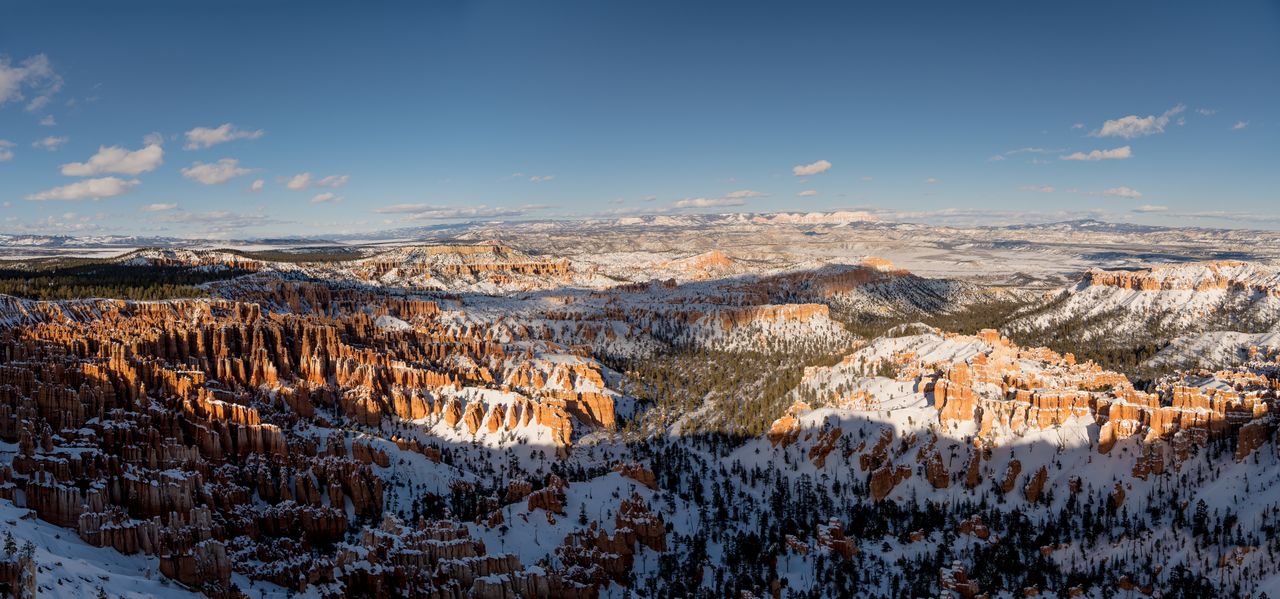
Bryce Canyon-forum threads on winter visits confirm this runs genuinely cold and often snow-covered, the park's 8,000-foot elevation making it consistently the coldest and snowiest of the nearby Utah parks in January. Posters describe the main amphitheater viewpoints and rim trails as generally passable, but the popular Bristlecone trail is routinely impassable once snow accumulates, and Yaktraks or microspikes are standing advice given how icy conditions can get. Main roads are reliably plowed, typically clear again within a day or two of a storm, and closures beyond that window are rare. Regulars note snowfall totals have run genuinely erratic in recent years, some winters surprisingly light and others delivering a proper deep base. The famous hoodoos under fresh snow are worth the cold for anyone willing to layer up properly. The record: 1.1C days feeling like -3C, -10.7C nights, a notably high 57.1cm of fresh snowfall and 67 percent humidity.
Bryce Canyon-forum threads on a mid-February visit describe only about half the scenic drive as typically open this time of year, posters calling the closed southern section a real limitation worth planning around. Regulars call icy, snow-packed trails the standing condition on the rim and canyon routes, real traction devices like Yaktrax or crampons genuinely essential rather than optional. Posters describe some winters delivering a snow-free week or two of clear blue skies, February generally a better bet for that stretch than March. Regulars call the frozen hoodoos under fresh snow a genuinely striking sight worth the cold. Posters recommend real expedition-grade layers regardless of forecast, temperatures here dropping to genuinely bitter levels overnight. Regulars recommend checking current road and trail status directly before any rim-to-rim plan this time of year. The record: 3.3C days feeling like -1C, -9.8C nights, 29.4mm across over 3 days and 66 percent humidity.
Bryce Canyon-forum threads on a March visit describe mid-March as genuinely still winter here, posters naming average-snowfall years as when many trails stay snow-covered well into the month. Regulars call mud a real hazard too, one visitor recalling trails so muddy they had to abort a longer hike partway through. Posters call the main amphitheater paths genuinely still open, several regulars naming Wall Street as the one notable exception, with the rest packed down from heavy foot traffic. Regulars call road conditions genuinely usually fine, several threads recommending itinerary flexibility anyway in case a storm rolls through. Posters recommend real waterproof boots with traction for a March visit, several regulars calling this standard given how much trails alternate between snow and mud this time of year. The record: 5.8C days, -7.2C nights, 40.3mm across over 6 days and 63 percent humidity.
Bryce Canyon-forum threads on an April visit describe conditions at this elevation, over nine thousand feet, as capable of turning genuinely cold with overnight temperatures easily below freezing. Regulars call most of the main park still doable in April despite the chill, real mud likely though flowers not yet out this early. Posters recommend a hotel room or cabin near Ruby's Inn for anyone visiting in April, a warm place to retreat once the sun goes down considered essential. Regulars call two days a solid plan, one for the main amphitheater area and a second for the scenic route and outliers like Mossy Cave and Fairyland. Posters call the road to Fairyland Point closed in early April, the Rim Trail from Sunrise Point offering a real hiking alternative to reach the same spot. The record: 11.8C days feeling like 10C, -3.6C nights, 15.4mm across nearly 3 days and 41 percent humidity.
Bryce sits at about 8,000 feet, and the forum's central point about June is that this makes it a different climate from the parks around it: reckon on roughly 20°F cooler than Zion's canyon floor, following the rough rule of about 5°F lost per thousand feet climbed. In practice June days here are comfortable, near 23°C, while nights fall into single digits — regulars say bring at least a fleece or light sweater and long trousers even in midsummer, plus a light shell for wind and the odd shower. If you are camping or staying up on the rim, the cold nights are the part people underestimate.
Bryce Canyon-forum threads on August accommodation and heat describe this as a genuine escape from the rest of Utah, the roughly 8,000-plus foot elevation keeping daytime readings in the comfortable eighties Fahrenheit while lower-elevation parks nearby bake closer to a hundred. Posters call nights here genuinely cool regardless of how warm the day ran, a real jacket standing advice for evening plans at the rim. Regulars describe August as sitting within the region's monsoon window, an afternoon thunderstorm entirely possible though whether a given trip gets caught in one is genuinely a toss-up. Posters recommend checking a current forecast before any exposed hike given how quickly a storm can build over the amphitheater. Regulars call the hoodoo formations worth the trip regardless of conditions. Posters recommend layering for the day-to-evening swing this elevation produces. The record: 24.9C days feeling like 23C, 8.5C nights, a low 39 percent humidity and 12.2 hours of sun.
Bryce sits around 8,000ft and the forum's September advice is entirely about what that does after sunset: days are pleasant, highs near 74F, and the temperature falls away sharply at dusk, with nights that can approach freezing. Jeans and a sweater are the standing recommendation for the higher viewpoints even on a warm afternoon, because the rim is colder than anywhere you drove up from. On crowds the answer is simple - come after Labor Day, when the school year restarts and the park thins out. The hoodoos are best seen either from the Rainbow Point drive and its viewpoints or from the rim trail round the main amphitheatre. The record: 21C days, 4.1C nights, humidity 38 percent, 3.1 precipitation days and 11.1 hours of sun.
Forum posters call December genuinely 'hit or miss' - it can be snowy or fairly mild and sunny, with no way to know in advance which a given visit will get. Sitting at over 8,000 feet (roughly 4,000 feet higher than nearby Zion), Bryce runs consistently colder, and posters say there may be too much snow for safe below-the-rim hiking but not quite enough for proper cross-country skiing - a genuine in-between that requires flexibility rather than a fixed plan. The road past the main amphitheater is typically unplowed and closed in winter. The clear upside repeatedly mentioned: crowds are essentially nonexistent, and snow-dusted hoodoos are called a genuinely spectacular sight when conditions cooperate - with nearby lower-elevation Zion named as the flexible fallback if Bryce's weather turns bad mid-trip.
Dodaj własną notatkę z karty miejsca na mapie — Park Narodowy Bryce Canyon.